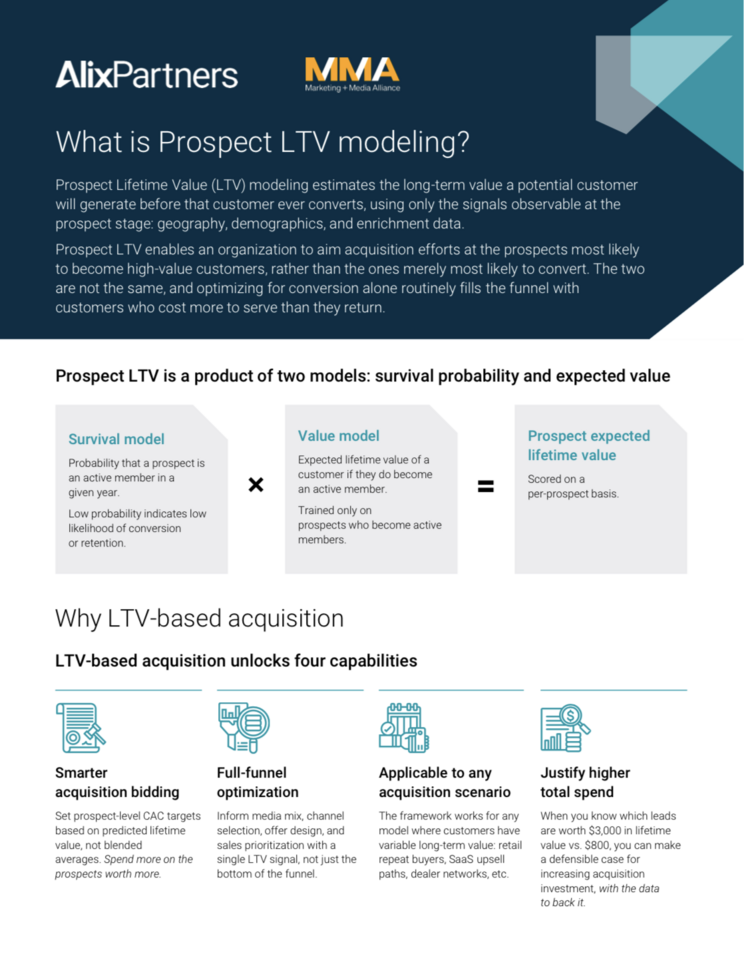
What to do when you have maximized your conversion rate?
Most acquisition models are built to find people who are likely to buy. But a customer who converts is not the same as a customer who stays, spends, and becomes valuable over time. When conversion rate is the target, marketers end up optimizing for the easiest line to cross instead of the most valuable relationship they could build.
Brunswick Corporation hit that ceiling at Freedom Boat Club, its fastest-growing consumer business, with roughly 100,000 members and 450 locations. After lifting lead-to-sale conversion from about 3.5% to nearly 8%, the team was running out of room to optimize. So they asked a different question: which prospects will become high-value, long-tenure members, and how can marketing find more of them?
In this webinar from Marketing + Media Alliance (MMA), Brunswick CMO Lauren Beckstedt and AlixPartners Managing Director Patrick Anglin walk through the MATT Future Lab model they built together. It predicts lifetime value at the individual prospect level, before anyone becomes a customer, so marketers can decide whom to target and how much to spend to acquire them. Back-testing estimates a 20% lift in acquired lifetime value for the same marketing spend.
What you’ll learn
- Why conversion-rate optimization eventually plateaus, and what comes next
- How a prospect-level LTV model combines predicted tenure and annual value, including real costs to serve
- How the team narrowed 200+ candidate signals to a focused, explainable set of 10 to 20 variables
- Which predictors surprised them, from younger prospects to member density and kids in the household
- Which industries are the best fit for LTV-based prospecting, from financial services and travel to telecom and enterprise software
- Three ways to start in your own organization: audit your acquisition model, run an in-market test, or join the MATT Future Lab