July 30, 2026
Prrincey Roy - Co-Founder & CEO, Huella
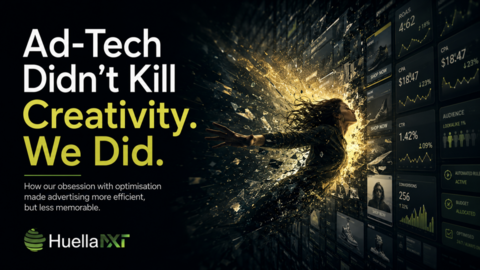
Over the last decade, advertising technology has become remarkably sophisticated.
We can identify the right audience, reach them at the right moment, optimise every impression and measure almost every action that follows. We have better data, smarter bidding, sharper audience segments and more detailed attribution than ever before.
That is real progress.
But I often wonder whether, in our pursuit of efficiency, advertising has lost some of its ability to make people feel something.
Having spent years working in advertising and ad-tech, I see most campaign conversations eventually return to the same questions: What is the CPM? What is the CTR? What is the ROAS? Can we improve the conversion rate? Can we bring the cost down further?
These questions matter. Businesses need accountability, and media investments need to deliver results.
But they cannot be the only questions we ask.
We should also be asking whether anyone noticed the advertisement, whether it made them pause, whether it created curiosity and whether they will remember the brand tomorrow.
A campaign can look impressive on a dashboard and still leave no meaningful impression on the person who saw it.
More precision, less distinction
Advertising today is more measurable than it has ever been. At the same time, a large part of it has started looking increasingly similar.
The same visual templates. The same predictable headlines. The same product-first opening. The same call to action. The same small creative variations tested repeatedly in the hope of improving a metric by a fraction.
We have become very good at optimising the delivery of advertising. I am not sure we have become equally good at creating advertising that deserves attention.
The issue is not programmatic advertising, artificial intelligence or automation. These are powerful tools, and they have solved many genuine problems for the industry.
The issue begins when efficiency becomes the objective rather than the enabler.
Technology should help a strong creative idea travel further, adapt intelligently and perform better. It should not reduce every idea to the safest version that a platform can easily deliver and measure.
Algorithms can find people. They cannot make people care.
Technology can tell us where an audience is, what they watched, what they searched for and what they may be interested in next.
It can identify intent, select the right device, determine the best placement and optimise the time of delivery.
But it cannot guarantee emotion.
An algorithm may identify the ideal consumer, but it cannot automatically create an idea that matters to them. A dashboard can tell us whether someone viewed an advertisement, but it cannot fully explain why they remembered it. An attribution model can show that a conversion happened, but it cannot always explain why a campaign became part of a conversation or changed the way people felt about a brand.
That still requires human insight.
It requires an understanding of behaviour, culture, emotion and the small human truths that make an idea relatable.
Perhaps one of the biggest challenges in modern advertising is that we have started confusing what is measurable with what is meaningful.
Impressions, clicks, completion rates, conversions and cost per acquisition are all important. But not everything valuable produces an immediate click.
A powerful campaign may shape how someone sees a brand long before they search for it or purchase from it. A memorable idea may stay with someone even when its impact does not appear neatly inside an attribution window.
Brand building is rarely immediate, and emotion does not always fit perfectly inside a campaign report.
The campaigns we remember
Think about the advertisements that have stayed with you over the years.
You probably do not remember their CPM, targeting settings or click-through rate.
You remember the idea.
You remember the line, the visual, the music or the emotion. You remember how the campaign made you feel.
The strongest brands were not built only by buying cheaper impressions. They were built by creating stronger impressions.
That distinction is important.
This is not an argument against technology. The future of advertising will not be won by choosing creativity over data, or data over creativity.
AI can help teams work faster. Automation can remove repetitive tasks. Programmatic technology can deliver campaigns with greater precision and scale. Data can help us understand audiences better.
But creativity must remain at the centre.
Technology should help us personalise an idea without removing its soul. It should help us make advertising more relevant, more interactive and more measurable without making it predictable.
The next era of advertising will belong to those who can combine the precision of machines with the imagination of people.
For years, we have focused on whether we can reach the right audience, reduce costs, and improve conversion rates.
Perhaps we need to add one more question:
Will anyone remember this?
Because media can deliver reach. Technology can improve efficiency. Data can sharpen decisions.
But creativity is what gives people a reason to notice, feel and remember.
And in a world where audiences can skip or ignore almost anything, memorability may be one of advertising’s most important performance metrics