 Andy Hasselwander
Chief Analytics Officer, Marketbridge
Andy Hasselwander
Chief Analytics Officer, Marketbridge
 Vassilis Bakopoulos
SVP, Head of Industry Research, Marketing + Media Alliance
Vassilis Bakopoulos
SVP, Head of Industry Research, Marketing + Media Alliance
 Raj Chavali
VP, Marketing Analytics, Endurance
Raj Chavali
VP, Marketing Analytics, Endurance
 Polis Pavlidis
Sr Director, Marketing Analytics & Data Science, Visa
Polis Pavlidis
Sr Director, Marketing Analytics & Data Science, Visa
 Pam Piligian
Chief Marketing Officer, SVP, Navy Federal Credit Union
Pam Piligian
Chief Marketing Officer, SVP, Navy Federal Credit Union
Most Marketing Analytics Isn’t Driving Decisions. Is Yours?
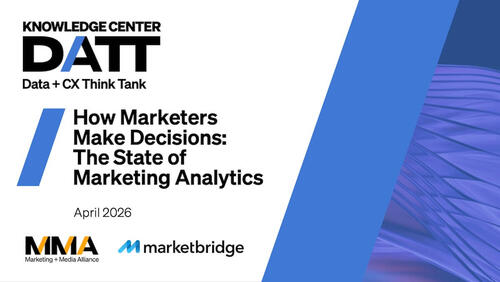
New research from the Marketing + Media Alliance (MMA) and Marketbridge reveals a stark reality: most marketing teams have built analytics systems that explain performance but don’t improve it. Only ~30% of marketers consistently use data to make decisions. Join us to learn what they do differently.
You don’t need more dashboards. You need better decisions. Based on a survey of 100+ senior marketers, this session breaks down why most analytics programs stall—and how leading organizations turn measurement into a strategic advantage.
If your team is struggling to connect data to action, this webinar will show you where the gap is—and how to close it.
What You’ll Walk Away With
- A clear benchmark of where your organization stands vs. the top 30%
- The biggest reasons analytics fails to influence decisions (even when the data is “good”)
- A practical model for turning reporting into decision-making
- How leading teams build trust in data across marketing and finance
- Ways to connect short-term optimization with long-term growth measurement
- Immediate ideas you can apply to improve how your team uses analytics
The Reality Most Teams Are Facing
- Only 36% of marketers fully trust their data
- Most organizations sit in the middle—functional, but not decision-driven
- Fast metrics (platform reporting, A/B testing) dominate
- Strategic measurement (MMM, incrementality) is underutilized
- The #1 challenge: balancing short-term results with long-term growth
The result: analytics that explains the past but doesn’t shape the future.
What the Top 30% Do Differently
This session will unpack how leading organizations:
- Align measurement directly to business strategy
- Treat first-party data as a strategic asset
- Build stronger collaboration between marketing and finance
- Use analytics to guide decisions—not just justify them
If your analytics isn’t changing decisions, it’s not doing its job.
Join MMA and MarketBridge to see how leading marketers are closing the gap—and what you should do next.