July 6, 2026
India’s most senior marketing leaders share tips and tricks to crack SMARTIES gold. The work they evaluate at this stage is already good. Here is what they said about the difference between shortlisted and winning.
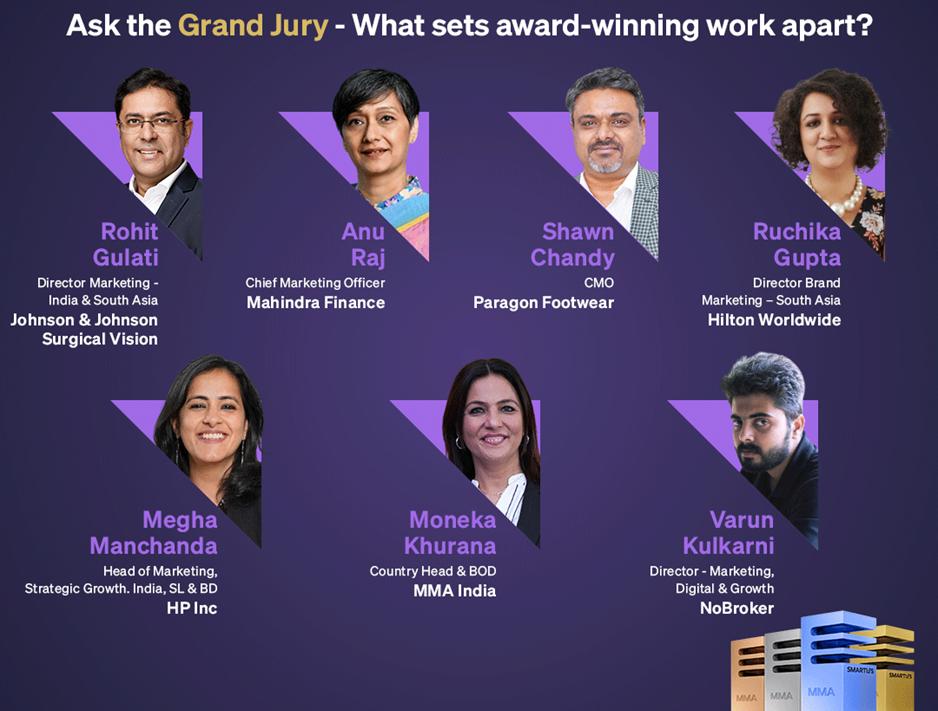
As MMA SMARTIES India 2026 nears the entry deadline, the Grand Jury shares tips, tricks, and candid answers on what cracks gold vs what just glitters. This quorum evaluates campaigns that have already passed the qualifying filter. By the time an entry reaches this stage, weak storytelling and mismatched categories have been cleared out. The campaigns are credible. The question the Grand Jury asks is harder: did this campaign earn its result, or did it merely benefit from a favourable market, a generous budget, or a well-produced case film? That distinction — between a campaign that genuinely drove business impact and one that described it convincingly — is what the Grand Jury is trained to find.
Q1 What are the three most common mistakes that prevent strong work from advancing?
The answer came back with striking consistency: the problems are rarely with the quality of the work. They are with how it is presented, proven, and packaged.
Three failure modes surfaced across every juror’s response:
- Numbers that do not reconcile: A claimed result that is out of proportion to the stated budget, or an impact figure with no baseline, stops the jury from trusting everything else in the entry. If the numbers cannot withstand scrutiny, the whole submission loses credibility regardless of how good the underlying campaign was.
- Attribution overreach: Claiming sole credit for a result shaped by external factors a market expansion, seasonal demand, a competitor’s stumble — without acknowledging any of it tells the jury the entrant has not thought rigorously about causality.
- Sameness at the shortlist stage: By the time entries reach the Grand Jury, many describe similar outcomes in similar language. The entries that advance have a distinct point of view about why the work worked not just evidence that it did.
A fourth pattern came up repeatedly: submitting the same entry unchanged across multiple categories. It signals a tactical, checklist-oriented approach rather than genuine strategic fit — and jurors notice.
“Don’t tell us what you did. Tell us why it worked — and make the proof hold together.”
Q2 How important is the craft of the submission — case video, write-up, storytelling — in determining winners?
Craft cannot substitute for substance, but poor craft can destroy it. Clear, information-rich entries with genuine evidence of a win will cut through even the most beautifully produced case film with weak proof. But the converse is also true.
The practical reality is that Grand Jurors are reviewing significant volume at speed. If the business impact is not apparent in the first ninety seconds of the case film, or the first paragraph of the write-up, it will be missed — not because the jury is not paying attention, but because the entry failed to earn attention quickly enough.
- Lead with the most important thing: The business problem and the result. Work backwards from there.
- Treat the case video as a structured argument: Problem → insight → execution → result. Not a highlights reel.
- Packaging signals commitment: If you have done genuinely impressive work, present it as if it deserves to be seen. A strong case poorly written makes even a careful reader skim.
“Your entry isn’t competing against campaigns. It’s competing against juror fatigue. Tell your story well.”
Q3 How do you evaluate business impact when categories, budgets, and objectives are not directly comparable?
This is the question that surfaces most often in jury rooms, and the Grand Jury’s answer reflects a consistent philosophy: evaluation is not a head-to-head comparison. It is a contextual one.
Jurors are not asking “which campaign achieved a bigger number?” They are asking “did this campaign do something extraordinary given what it was working with?” A challenger brand that defied category gravity, a modest-budget entry that wildly outperformed its own stated objectives, a market-entry campaign that shifted real consumer behaviour — these can all beat a high-budget campaign that simply performed well.
Three questions appear to guide the evaluation regardless of category or scale:
- Did the entry clearly define what success was supposed to look like before the campaign ran?
- Did the results beat what is normal for a brand of this size, in this category, at this stage?
- Does the story of how the campaign caused the result hold together under scrutiny?
“A ₹10 crore campaign doubling sales and a ₹10 lakh campaign transforming a business can both be gold-worthy. Context is the great equaliser.”
The jury also addressed the distinction between strong marketing and strong creative execution. Strong creative without effectiveness is a craft award. Strong effectiveness without creative distinction is a business case. SMARTIES is designed to reward the intersection of both.
Q4 What are the top red flags that weaken an otherwise shortlisted entry during final evaluation?
By the final round, every entry on the table has passed multiple filters. The red flags that emerge at this stage are subtler — and more damaging, because they appear in work that should win.
- Campaign metrics presented as business outcomes: Impressions, reach, and engagement are not business impact. When a results section reads like a media report rather than a business case, it raises an immediate question about whether the campaign actually drove anything that matters to the brand’s commercial performance.
- Unacknowledged attribution gaps: Any result that could reasonably have been caused by something other than the campaign needs to be explicitly addressed. The best entries acknowledge these factors and demonstrate the campaign’s contribution despite them.
- Absence of originality: A case study that reads like a templated effectiveness submission or one the jury has seen before — will not advance. What separates the final winner is one thing they can say that no other entry in the category can.
- Technology as narrative decoration: A 2026-specific flag: AI and advanced technology used primarily to create a more compelling case study narrative, with a visible gap between the story told and what the brand actually did in-market. The jury is watching for it.
“Once you’re shortlisted, everyone here is good. What separates the winner is one thing they can say that nobody else in the category can.”
Q5 If 2026 has one new benchmark for marketing excellence, what should it be?
This question produced the session’s most varied responses. Where questions about mistakes and red flags yielded consensus, the question of what marketing should aspire to drew genuinely different answers — each reflecting a distinct view of where the industry is heading.
- Meaningfulness: Brands have mastered targeting, personalisation, and automation. The next frontier is a harder question: will consumers miss this brand if it stopped? The benchmark is not efficiency it is relevance that consumers choose, not relevance that is served at them.
- Progressive measurement: The tools available to marketers in 2026 media technology, creative technology, first-party data — demand a higher standard of reporting effectiveness. The benchmark is a measurement system that is forward-looking, not retrospective.
- Trust at scale: AI has made content creation faster and more accessible than at any point in history. The differentiator is not the content it is whether consumers believe it. Brands that use AI to create authentic, genuinely valuable experiences will build something no algorithm can replicate.
- Earned attention: In an environment of compounding distraction, the highest achievement is undivided consumer attention whether through community, sustained engagement, or repeat behaviour. It cannot be bought. It can only be earned.
“Technology can scale execution. Trust is what scales brands.”
Q6 What advice would you give entrants who want to move from shortlisted to winner?
The advice converged on one idea: the work is not the gap anymore. At the shortlist stage, the campaigns are good. What separates the winner is clarity — of the problem, the proposition, and the proof.
The jury offered a specific exercise: before finalising any entry, articulate the award proposition in a single sentence. What did the campaign solve? What did it create? Why should the jury care? If that sentence requires more than one clause to be honest, the entry needs more work.
A simple practical test also surfaced: read the entry out loud. If it sounds like it is being performed rather than told, simplify. The strongest submissions make it effortless for the jury to understand — not just impressive to experience.
- Write for the judge, not for yourself: The judge has not lived inside this campaign for twelve months. Give them everything they need to understand why it deserves to win problem, approach, proof — without making them work for it.
- One entry, one story, one category: The entries that win at this stage are the ones where every element is working. If the same narrative has been entered into multiple categories unchanged, the jury will know.
- Scrutiny tightens at every stage: What passes the qualifying round is not what wins the Grand Jury. The standard here requires a sharp, data-driven narrative that connects objectives, strategy, and measurable outcomes without gaps.
“Write for the judge, not for yourself. Be crystal clear about the problem, what made your approach distinctive, and the impact it delivered.”
The Grand Jury evaluates the very best work—but every winning entry starts with the Qualifying Jury. Read what they expect from every submission before you hit enter.
What earns the Gold is the entry that makes it effortless for the most senior marketing minds in India to understand, believe, and champion it.
Submit your entry - mmaglobal.com/smarties-2026
On-time deadline: July 9 · Extended: July 21 · Gala: October 9, 2026 · Taj Land’s End, Mumbai