March 24, 2026
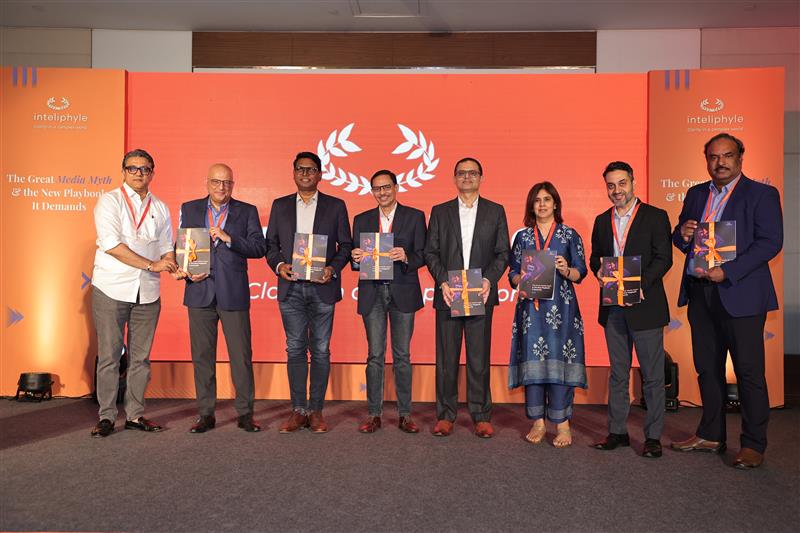
Mumbai: At a time when media strategies are increasingly skewed towards digital, new findings from Inteliphyle suggest that effectiveness lies in integration rather than substitution. Presented at The Big Media Reset conclave, the Unified Media View Study (UMVS) offers a data-led perspective on how Indian consumers are engaging with multiple media platforms in 2025.
The study is based on a single-source sample of 12,124 affluent urban consumers across Delhi, Mumbai and key Hindi-speaking markets. It shows that media consumption has grown across platforms between 2019 and 2025. While internet usage has expanded significantly, traditional media such as television and print have also increased their reach, indicating that consumers are adding platforms instead of replacing them.
The findings point to a clear distinction between reach and impact. Newspapers record the highest Net Trust Score at 52%, compared to 40% for television, 32% for online news, and 26% for radio. This trust advantage translates into stronger engagement, with audiences who trust a medium spending +15% to +29% more time with that medium.
Attention metrics have a strong case for print and television. Newspapers and television lead with a Net Attention Index of 56% and 55%, respectively, ahead of the digital platforms (Social Media at 46%, and
Online news at 33%). In addition, newspapers show significantly lower distraction levels, with only 10% of readers engaging in non-media activities while consuming print.
“Consumers today are not replacing one medium with another. They are layering them,” said Prasun Basu, co-founder and CEO of Inteliphyle. “This reinforces the need for media strategies that recognise the complementary roles of different platforms.”
Tennis Mathew added that effectiveness can no longer be measured through reach alone. “High reach without trust and attention limits impact. Platforms that deliver credibility and focused engagement are critical to driving stronger outcomes,” he said.
The study also highlights regional variations in media consumption. In Hindi-speaking markets, traditional platforms continue to deliver strong reach and influence. This makes a case for more localised planning approaches rather than uniform strategies across geographies.
On measurement, Vikram Sakhuja noted that fragmented metrics remain a challenge. “Evaluating platforms in silos does not give a complete picture of effectiveness. There is a need for a unified approach that captures how different media channels work together,” he said.
The UMVS findings underline that while digital continues to scale rapidly, traditional media retains a strong role in building trust and attention. For marketers, the focus is shifting towards creating balanced media mixes that combine scale with depth and deliver more meaningful engagement.